Jeremy Kennedy’s Music Journey is Just Beginning
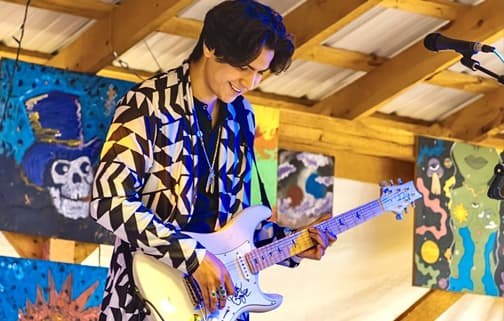
Jeremy Kennedy (Wolf Clan) carried his big news quietly, holding it in for what felt like a lifetime.
When the call came four months before the Syracuse Area Music Awards (SAMMY’s), it caught him completely off guard. They told him he had won the SAMMY Award for Best New Artist, but for now, it had to stay a secret.
Jeremy remembers the brief call: “She told me I was going to receive the award, but not to tell anyone until a certain date…all I could remember thinking was, ‘oh my goodness is this really happening?’”
It felt surreal at first, but as the event approached, the moment began to sink in. The award was a tangible acknowledgment of his talent and dedication to his new craft. Jeremy thought about how far he’s come in such a short time.
“I just remember how excited I was…and it’s such an honor,” he said. “But I was walking around with this giant secret in my head that I couldn’t say to anyone.”
That meant keeping it from the people closest to him—his bandmates, the ones he shared stages and rehearsals with, and his parents, who had supported him from the beginning.
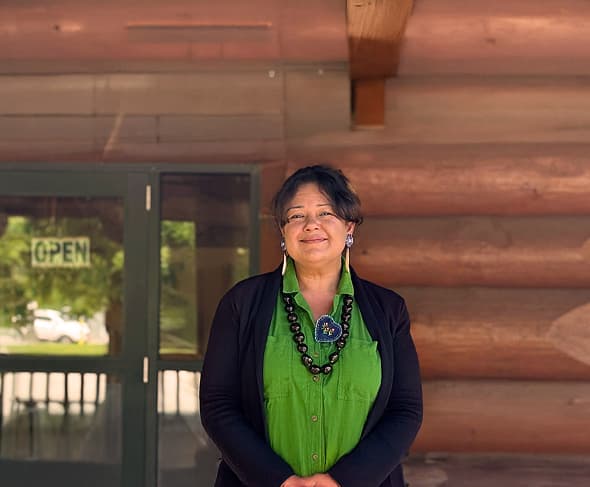
When he finally accepted the award, Jeremy reflected on the role his parents played in shaping his musical journey. Music had always been a constant in his life, filling the background of his childhood. At home, his mother Tammy Bluewolf-Kennedy (Wolf Clan) always had something playing—classic rock from the ’70s, alternative from the ’90s, and early 2000s bands that blended genres.
Being surrounded by music felt natural. Learning to create it, however, was something he had to figure out on his own.
At nine years old, Jeremy discovered a piano interface on his mother’s tablet and began experimenting. There were no lessons or formal instruction—just instinct, curiosity, and repetition. Even now, he laughs at how confidently he approached it, trusting himself to figure it out as he went.
A few years later, that curiosity expanded to guitar. After attending his first concert—Green Day—he left with a clear sense of direction. He wanted to perform, and guitar became the path forward.
Even that moment came with a bit of anticipation. The first guitar he received had a small crack, and his parents planned to return it. For a while, it stayed in the box—out of reach, but impossible to ignore. The wait only made him more eager.
Eventually, he convinced his parents to keep the guitar. From there, the shift was immediate.
Still, performing didn’t happen overnight. Jeremy didn’t play his first live set until he was almost 18, stepping onto the stage at an open mic after some encouragement from a friend. What started as a single performance quickly became something more consistent.
Open mics turned into bar shows. Bar shows grew into festival opportunities. Each step forward required initiative and persistence. Looking back, it was a constant reminder that success in music isn’t passive. You have to be willing to put yourself out there.
That same mindset carried into the formation of Jeremy’s band, Sacred Medicine. The name reflects a deeper belief that music is more than entertainment. It’s something that heals and connects people. For Jeremy, that idea has always been central to what he creates.
“I’ve always believed music’s been healing,” he said. “It brings people together. It’s something sacred.”
Playing alongside bandmates who share Indigenous roots added another layer of meaning. It wasn’t just about making music—it was about channeling something larger than themselves.
By the time the award ceremony arrived at the Palace Theater in Syracuse’s Eastwood neighborhood, Jeremy had spent months processing the moment. Even so, stepping into it felt new.
“It was sold out,” he said. “I got to do a speech, saw a lot of familiar faces, met new artists…it was a really wonderful experience.”
His bandmates were there, along with his parents—the same people who had supported him from the very beginning, driving him to gigs, helping him get equipment, and showing up no matter the setting.
But even as Jeremy stood on stage, recognized for what he had accomplished, his thoughts quickly turned forward.
He’s been working toward a full-length album, something he sees as a critical next step. More than just live performances, he wants to create something lasting that people can return to anytime.
“What I want to do is create something bigger than myself,” he said. “A real musical legacy.”
Later that night after the event, the meaning of the moment came into focus.
For Jeremy, the recognition is special, but it’s also a step forward. One that brings more opportunity, more visibility, and more reason to keep going.
Read more of the latest news